School and Campus Profile
Getting to Know the Educational Institution
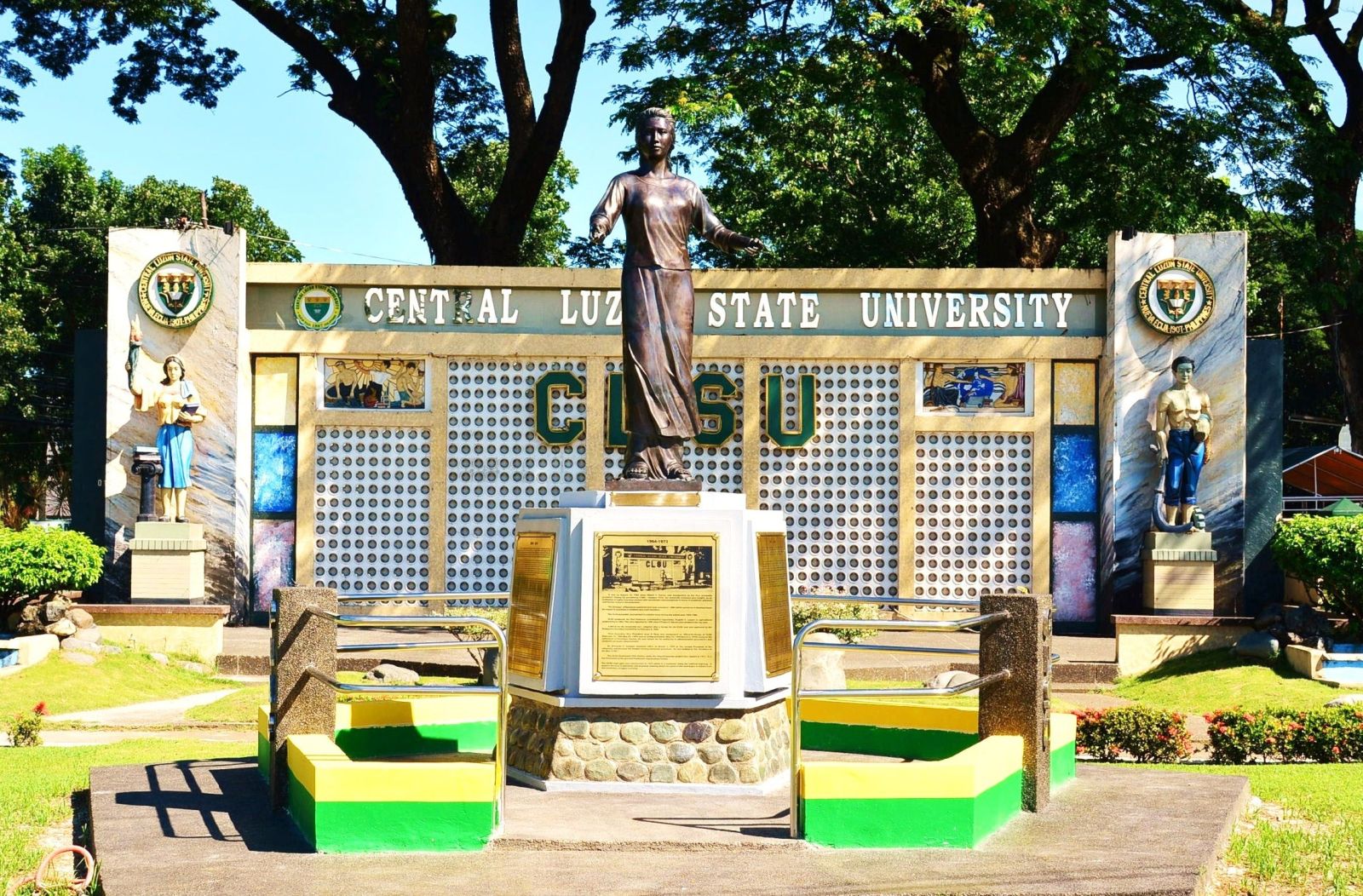
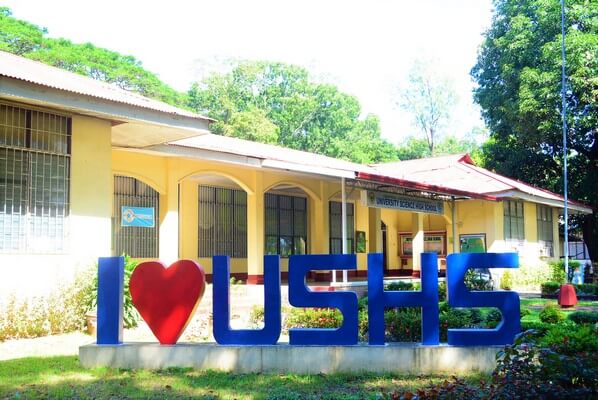
Central Luzon State University (CLSU) is a premier state higher education institution in the Philippines, dubbed the Science City. Under the umbrella of the College of Education at CLSU, the University Science High School (USHS) and Senior High School (SHS) serve as partner schools for teaching practicums with international learning standards. Combining national-scale agricultural research facilities with modern pedagogy, this school provides a comprehensive learning experience and supports the holistic development of students, both in the classroom and on the field.
Participants
411 Students (SY 2025-2026)
General Overview
Important and concise information about this activity
Extensive Facilities & Research
Situated on a 658-hectare campus, it is equipped with a modern library, cutting-edge science laboratories, and national research centers (such as the Philippine Carabao Center).
Selectivity & Quality
USHS has a highly competitive admission system (accepting only ~80 students/year), while the SHS accommodates students across various structured academic strands.
International Partnerships
The campus is highly active in international student exchanges and cross-border collaborations, including hosting the SEA-Teacher Pilot Project Batch 5.
Center of Excellence
Officially recognized by the Philippine Commission on Higher Education (CHED) as a Center of Excellence in Teacher Education, Agriculture, and Veterinary Medicine.
Overview
Important and concise information about this activity
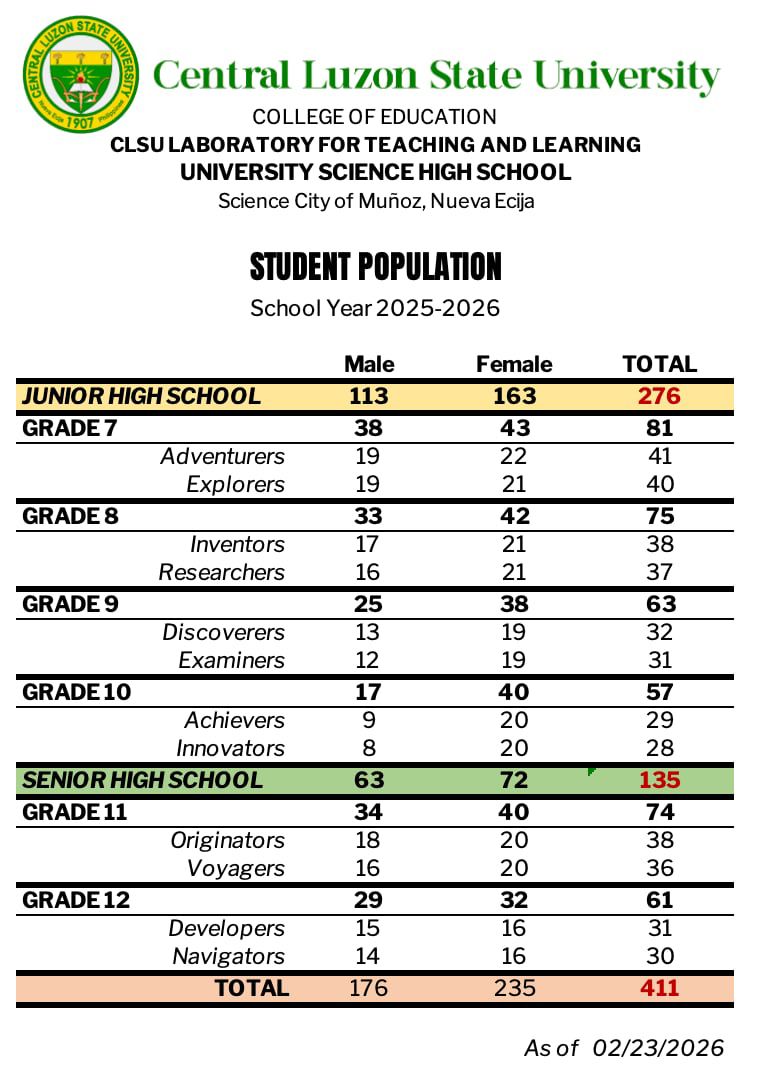
Student Population Report - SY 2025-2026 (As of 02/23/2026)
Institutional Profile
In-depth information about the structure, facilities, and flagship programs offered by the school.
Infrastructure & Facilities
The school provides learning facilities seamlessly integrated with the university ecosystem to support an optimal teaching and learning process.
- Excellent sports facilities and open fields designed for physical education field drills and activities.
- State-of-the-art science laboratories and access to integrated research centers like the Freshwater Aquaculture Center.
- A university digital library with a comprehensive collection of literature and electronic journals.
- International dormitories and support facilities for foreign exchange students and student teachers.
- A lush, green 658-hectare campus featuring agrarian and eco-friendly architecture.
Organizational Structure & Management
The school has a clear organizational structure integrated directly with the university's management.
- A University President with a global vision focused on research and sustainable development innovation.
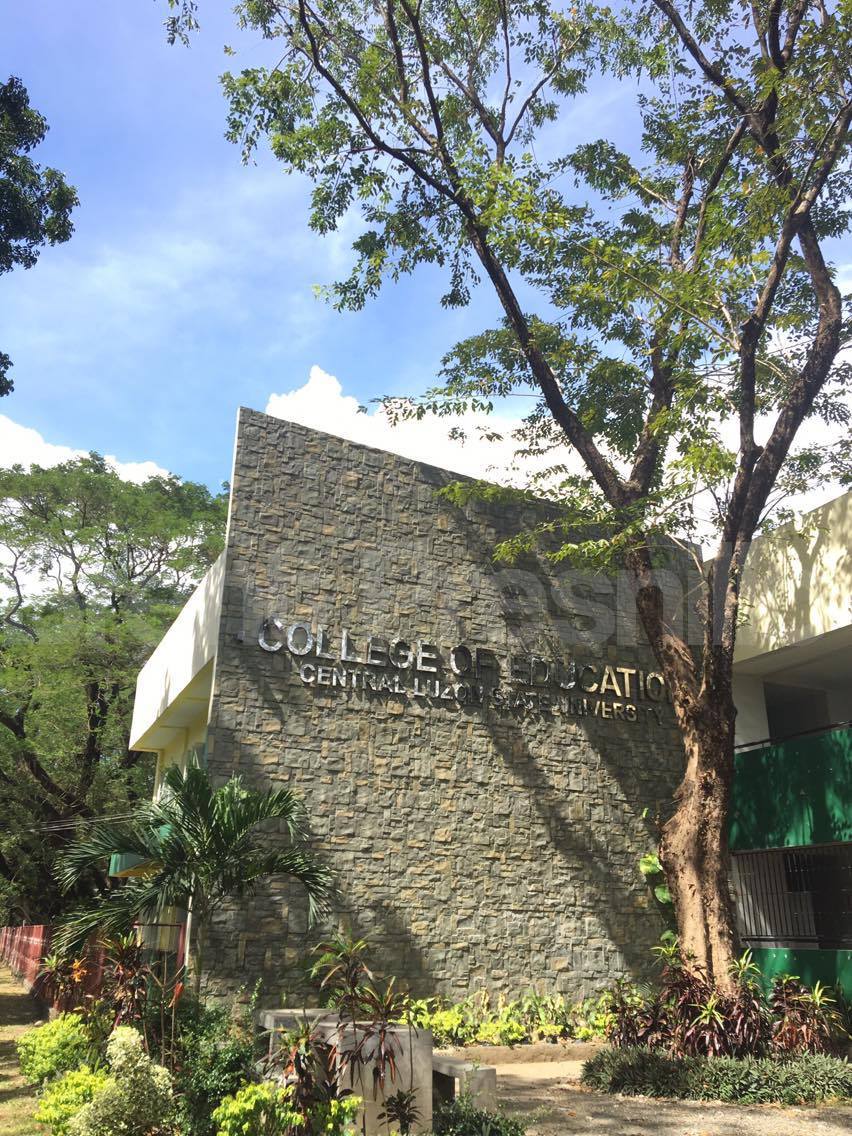
- USHS and SHS operate under the direct auspices and supervision of the Dean of the College of Education, CLSU.
- Supported by highly dedicated, certified Cooperating Teachers who guide student teachers, such as Sir Marc Alvin.
- Naming conventions for SHS sections that build positive identity and a spirit of exploration, such as the Voyagers and Originators classes.
- IT-based academic management and administrative systems.
Flagship Programs
The school offers various academic programs tailored to students' talents and future career goals.
- Enriched Curriculum at USHS: A heavy focus on Science and Mathematics, with a requirement to complete an original Science Research Project.
- STEM Strand at SHS: Prepares students to enter pure science, engineering, and medical programs at top universities.
- ABM, HUMSS, and TVL Strands: Provides specific expertise in business, social sciences, and practical vocational skills.
- A balanced integration of theoretical classroom learning and interactive field practice.
International Partnerships
CLSU maintains strategic partnerships with various international institutions to enhance educational quality and cultural exposure.
- Active collaboration with SEAMEO in organizing the Pre-Service Student Teacher Exchange in Southeast Asia (SEA-Teacher) program.
- Student and teacher exchange programs with educational institutions across Southeast Asia.
- Active participation of faculty and students in international academic conferences and publications (such as Scopus-indexed journals).
Campus Gallery
Visual documentation of program activities
School Highlights
Aspects that make CLSU, along with USHS and SHS, high-quality educational institutions
Learning Environment
Creates an interactive and student-centered learning atmosphere, where students are encouraged to actively participate and try out new instructions with confidence.
Our Community
Builds a campus culture (the CLSUans identity) that upholds the discipline of hard work combined with modern scientific thinking.
Academic Achievement
Students consistently achieve high marks, win international science competitions, and successfully enter top universities in the Philippines and abroad.
Educational Innovation
Continuously innovates in designing lesson plans that intelligently balance academic theory in the classroom with practical applications on the field.
Global Perspective
Broadens students' horizons toward cultural exchange by enthusiastically welcoming international student teachers.
Personal Development
Focuses on developing 21st-century skills, English communication abilities, and the mental and physical discipline of the students.
Personal Reflection
“"Getting to know this institution provided incredible insights into how physical education can be optimally integrated between academic theory and field practice within an advanced scientific ecosystem."”
— Personal Experience
During my participation in the SEA-Teacher Pilot Project Batch 5 at CLSU, I gained profound professional experience while observing and teaching directly at this school. Being under the College of Education, the school environment proved to be highly supportive of interactive teaching approaches. The comprehensive guidance from my cooperating teacher, Sir Marc Alvin, was key in formulating targeted pedagogical strategies for students in the Philippines. The most memorable moments for me were conducting the Basketball teaching demonstration for the Grade 11 Voyagers class on February 16, 2026, followed by the Volleyball theory and practice class for the Grade 11 Originators on February 23, 2026. Seeing the students' enthusiasm in responding to instructions and their confidence in trying out new techniques on the field proved that this institution not only produces brilliant scientific minds but also deeply cares about the development of fitness, collaboration, and motor skills of its younger generation.